Riva Aquarama upholstery: the vinyls and colours of each series
On a Riva Aquarama the upholstery isn’t simply a matter of taste: each series wore a particular vinyl, a particular colour scheme and a particular pattern of padding, and these changed with the years and with the hull numbers. A Politecnico di Torino study published in 2025 pieces that history together from Riva’s archive, the Riva Historical Society register and the yard’s own restorers. This is what it found, and what is worth knowing before retrimming one.
By Royal Stitch · Published
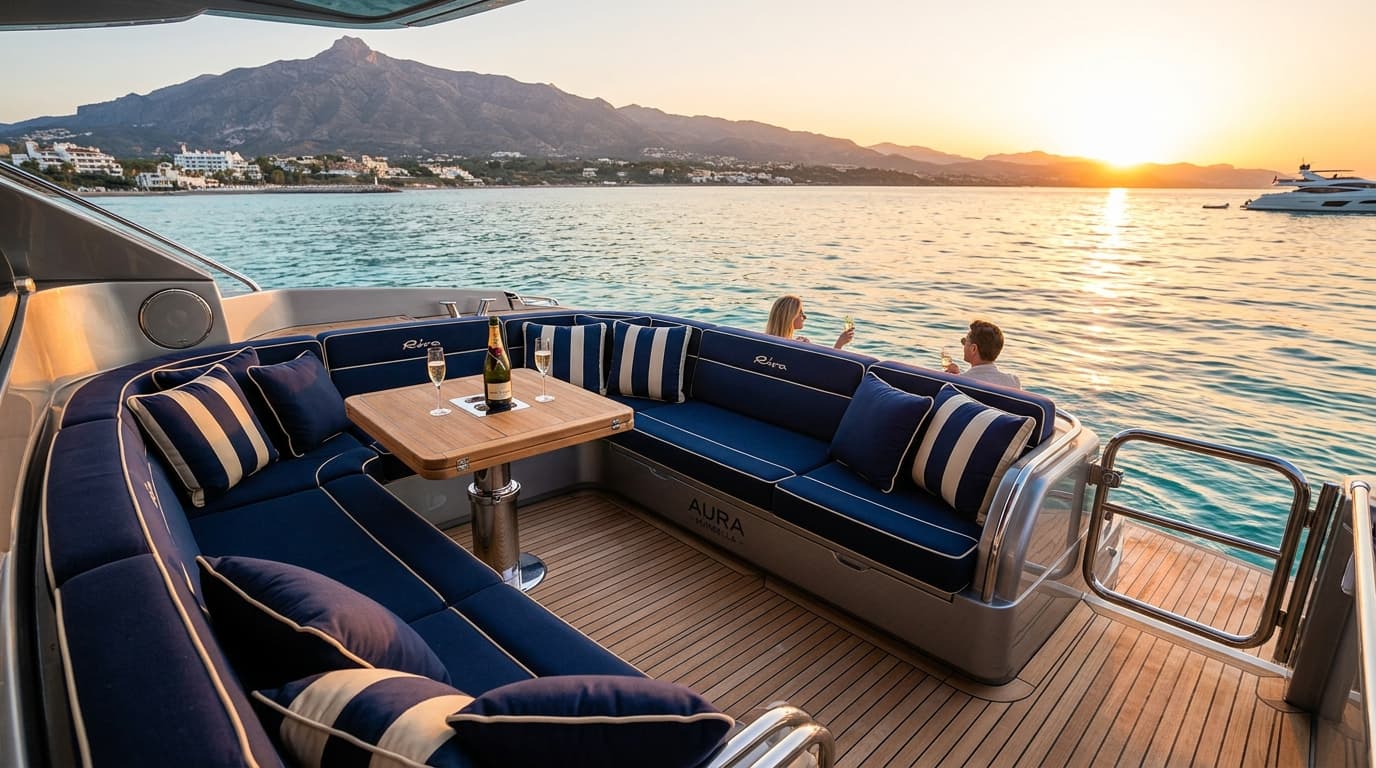 Illustrative image
A boat you know by its colours
The study, by Gianluca Grigatti, Francesca Mucchetti and Pierpaolo Peruccio in the Color Culture and Science Journal, starts from one idea: on the Aquarama, the colour of the upholstery is as much a part of the boat’s identity as the varnished mahogany. Carlo Riva designed it with the architect Giorgio Barilani; it was unveiled at the 1962 Milan Boat Show and built until 1996.
In the authors’ reading, the turquoise, the lobster orange and the cream grew out of a blend of influences, above all American car and aircraft design of the 1950s and 1960s, whose catalogues covered Carlo Riva’s desk. And the vinyls, Naugahyde and Italvipla, mattered as much as the colours.
From Resinflex to Naugahyde
The first Aquarama, in 1962, was trimmed in Resinflex, a synthetic leather from an Italian maker that had produced it since 1947: black side bands, cream cushions with horizontal flutes and coral piping. The seats came in two folding sections.
From Aquarama number 27, in 1964, Carlo Riva moved to Naugahyde, a vinyl imported from the United States that the study describes as softer and easier to clean. The pattern stayed the same, but the piping began to drift from coral towards orange, and the sun pad cushions were made in orange too, still in two pieces.
1962 · Resinflex
Black bands, horizontal flutes, coral piping.
1964 · Naugahyde
Same pattern; the piping turns orange.
1967 · Italvipla
Turquoise bands, vertical flutes, matching piping.
The 1967 turquoise
In 1967 the Aquarama’s upholstery moved to vinyl by Italvipla, and the design changed: turquoise side bands, cream seats and backrests with vertical stitching and fluting, and tone-on-tone piping. The backrests became more enveloping, and the sun pad went to three parts, two turquoise sides and an ivory centre, each in two folding sections.
According to the study, the schemes were fixed from hull 174: cream and turquoise for the Aquarama, cream and lobster orange for the Super.
The Super and the Special
The Aquarama Super, from 1963, started out with the base model’s scheme: vinyl with black bands, vertical cream padding and piping first in coral and, from 1964, in lobster orange, a deeper shade. From 1967 it followed the Aquarama’s changes with one difference: where the Aquarama wore turquoise, the Super wore lobster orange, on the steering wheel too, two-toned with cream.
The Aquarama Special, from 1971, was offered both ways: turquoise bands, carried over from the Aquarama, or lobster orange, as on the Super. Either way the seats were cream with vertical flutes; the outer sun pad cushions matched the bands and the centre one was cream.
The last boats
In the final series, from 1990, the standard trim went back to turquoise and cream, a pairing that also reached the cabin below, with cushions striped in both colours. In the last two years of production, the study notes, some hulls built for dealers, whose buyers weren’t yet known, were finished in plain cream.
Where each detail comes from
The authors rebuilt this history from several sources: the historical register compiled by the architect Gibellini of the Riva Historical Society, which records the features of each boat; the Aquarama book published by Assouline with the yard; and documents from Riva’s archive, including sales records annotated with colours and materials. They completed it with restorers and visits to Riva Classiche, the yard’s department that maintains, restores and stores historic boats.
For an Aquarama owner, these are also the places to look before choosing colours: what a hull left the yard in needn’t match what it wears today.
What to check before a retrim
With these answered, the new upholstery sits with the boat’s history:
- The hull
- Which number and which series? What do its register entry and sales record say?
- Colours
- Turquoise, lobster orange or cream? Is it the original scheme?
- Padding
- Horizontal or vertical flutes? Piping tone-on-tone or contrasting?
- Vinyl
- Which current vinyl will be used, and how does it compare with the period one?
- Sun pad
- Two pieces or three? In which colours?
The service
A classic Riva in need of new upholstery?
Cockpit, sun pad and cabin upholstery for boats on the Costa del Sol, patterned on each piece. The service page explains how the work is done.
Sources
Everything on the series, materials and colours comes from the Politecnico di Torino study, published open access in 2025, which in turn draws on Riva’s archive, the Riva Historical Society register and restorers at Riva Classiche. The study was opened and read in full.