

Leather or vinyl inside a boat
From a metre away, a good marine vinyl and a leather can look much the same. The difference shows in use: when someone climbs out of the sea and sits down, when the sun cream goes on, when the boat sits shut in harbour for weeks. Here is what their makers say about each, and a way to decide which goes where.
By Royal Stitch · Published
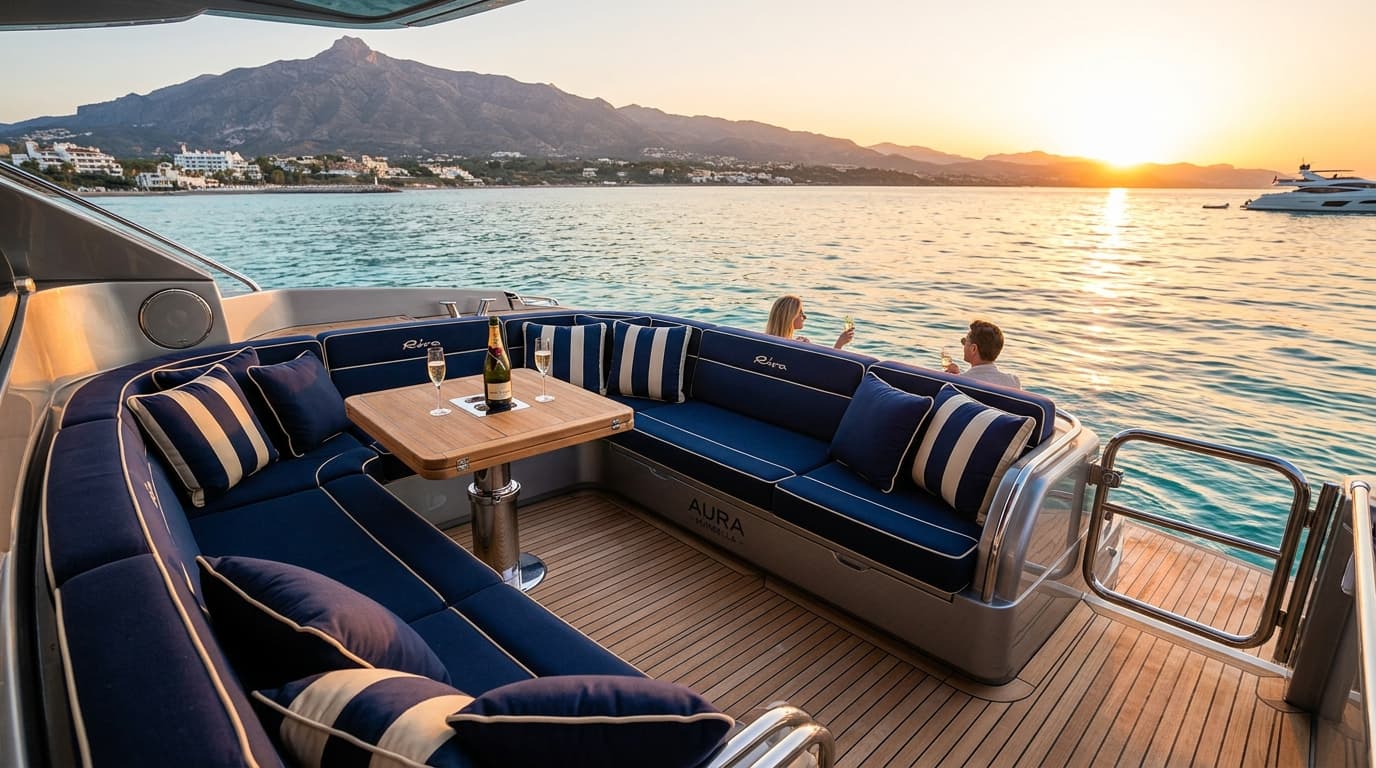 Illustrative image
What changes on board
At home, a leather sofa is sat on by people who are dry and dressed. On a boat, the saloon is a couple of steps from the bathing platform: people come in with wet swimwear, salt on their skin and fresh sun cream. And when the boat is left on its mooring, it is left shut, with the damp inside.
So the question isn’t which material is better, but what will happen to each seat. The same upholstery can be a sound choice in a cabin and a poor one in the dinette by the cockpit door.
Leather made for boats
It exists. Muirhead, a Scottish tannery that supplies the marine trade, says its stock leathers pass the British Crib 5 fire test and carry IMO certification — the International Maritime Organization’s. Its website describes Fairline using its leather for the saloon, the cabins and the helm seating of the Squadron 68.
For care, the same maker asks for vacuuming and a cloth dampened with mild soap — not detergent — without soaking the hide. It advises against spray polishes, saddle soap, waxes and so-called “hide foods”, which leave a sticky surface that attracts dirt and, in the end, does lasting damage.
What the site doesn’t cover is how leather copes with salt water or wet swimwear. Whether a particular hide will stand up to life afloat is a question for its technical sheet, not for a general rule.
Marine vinyl
Morbern, one of the big makers, calls it a vinyl-coated fabric in its care guide: a textile backing with a PVC layer on top. It doesn’t absorb water and wipes clean. Some lines are made to look like leather: Sailrite, which sells it, describes Morbern’s Carrara as a matte vinyl with the feel of fine leather, and Morbern lists it among its vinyls for boat interiors.
Its weak spot is chemistry. On the pages for several of its vinyls, Morbern warns that lotions, suntan oils, waxes and polishes contain oils and dyes that can stiffen and stain it. For a sun cream mark, its guide asks for lukewarm water and a sponge — no hot water or soap, which would set the stain — and rules out abrasives, citrus cleaners, solvents and wax.
Vinyl doesn’t look after itself. It needs little, but it needs the right little.
Where each belongs
Given all that, a sensible approach is to divide them by how each area is used:
Many interiors use both in the same shade, and the line between them is drawn with samples in hand, on the boat itself.
- Cockpit and the dinette by the door
- Where people sit straight out of the water: marine vinyl.
- Saloon
- If people come in dry and dressed, leather works. If it is an extension of the cockpit, vinyl is wiser.
- Cabins
- The most sheltered part of the boat, and the most natural home for leather.
The water
The path of someone coming up from the bathing platform.
Marine vinyl
Cockpit and the dinette by the door: where people arrive wet.
Leather
Saloon sofa and cabin: where people arrive dry.
When the boat is shut up
Neither wins here. The owner’s manual from Buster, a Finnish boatbuilder, warns that mould can grow on the inner face of foam and artificial leather, and says cushions shouldn’t be stored in constant damp or left to get waterlogged. The same thinking applies to leather: dry anything that got wet before locking up, and air the boat when you return.
Sun through portlights and windows counts too. The same manual notes that, over the years, ultraviolet light fades colours and shortens the life of the materials.
What to ask before deciding
With these answered, the choice follows the use, not the prettiest sample:
- Use
- Who sits there, and how do they arrive — from the water or from inside?
- Technical sheet
- Is the material made for boats? Which fire tests does it have, if the boat needs them?
- Cleaning
- What does its maker ask for, and which products does it rule out?
- Sun cream
- What does the maker say about sun lotions and oils?
- Laid up
- How long does the boat sit on its mooring with nobody aboard?
The service
Leather, vinyl or both?
Saloon, cabin and cockpit upholstery for boats on the Costa del Sol, patterned on each piece. The service page explains how the work is done.
Sources
The leather comes from the tannery that makes it; the vinyl, from its maker and a stockist; damp and sun, from a boatbuilder’s manual. Each source was found by searching the publisher’s own site.