

Marine upholstery materials: what stands up to salt, damp and sun
A deck cushion rarely fails at the fabric you can see. It fails inside: foam that holds water, thread the sun has weakened, a staple that rusts and stains. Here is what the sea asks of each layer, what its maker says about it, and what is worth asking before you accept a quotation.
By Royal Stitch · Published
 Illustrative image
What the sea does to a cushion
Three things at once, and none of them lets up. Sun, which breaks down the polymers almost every synthetic fabric and thread is made of, taking away strength and colour. Salt, left behind by every splash, which attacks any metal not made to cope with it. And damp, which gets into the filling and, with nowhere to go, stays there.
On the Costa del Sol all three are harder than further north. According to AEMET, the Spanish met office, midday UV indices of 9 to 11 are common across mainland Spain on clear summer days — “very high” and “extreme” on its own scale. And plenty of boats in Puerto Banús or Estepona spend the whole year on their berth, cushions out through the winter.
Which is why a deck cushion isn’t specified like a sofa cushion in a different cloth. It is specified layer by layer.
- Solution-dyed fabricTop and sides, where the sun lands.
- ThreadThe seam — first to give way to UV.
- Open-cell foamLets water and air through.
- Mesh baseWhere the water gets out.
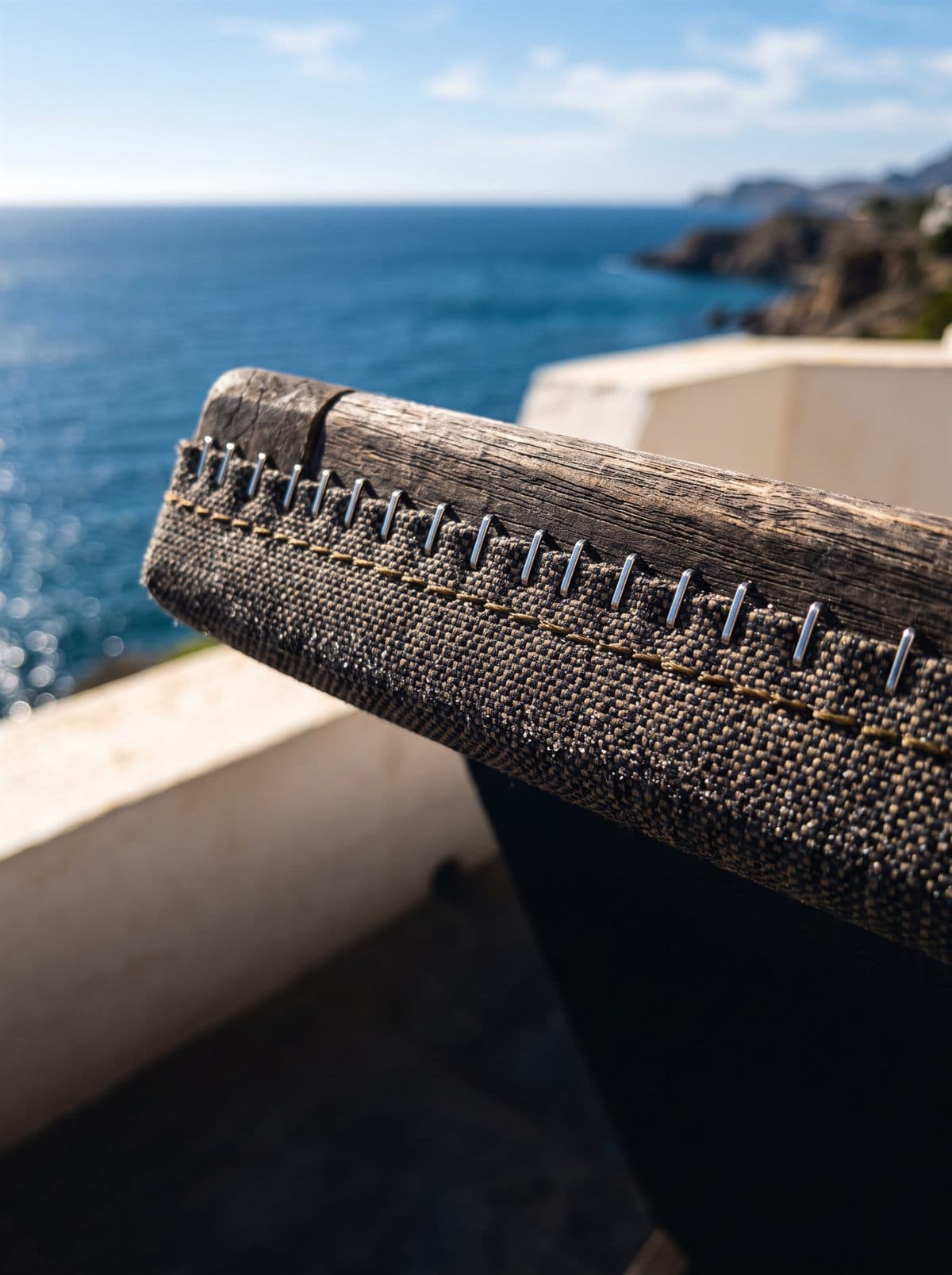
- Board and staples316 stainless where salt reaches.
The cloth: solution-dyed acrylic
Better marine acrylics are solution-dyed: the pigment goes in before the fibre is spun, so the colour runs right through rather than sitting on the surface. Sunbrella describes its fibres as saturated with colour and UV-stabilised pigments before they are spun into yarn; Sauleda, which weaves in Catalonia, says the same of its Masacril range. A cloth dyed afterwards carries its colour on the surface — exactly where the sun lands.
On mildew, Sunbrella is precise: its fabrics don’t promote mildew, but mildew can grow on dirt and residue left on them. In other words, no cloth replaces an occasional rinse with fresh water.
For stubborn stains and mildew the same maker allows a diluted bleach solution — and warns that bleach and the age of the fabric can affect the sewing thread and any components that aren’t its own. A neat illustration of why the cloth is never chosen on its own: whatever is done to the fabric is done to the thread as well.
Marine vinyl: waterproof, but particular about chemicals
Marine vinyl doesn’t breathe and doesn’t absorb anything. It wipes clean, which makes it the usual choice wherever people eat, climb aboard or sit down wet. Manufacturers treat it against mildew and formulate it to take sun and cold without cracking.
Where it suffers most is in the cleaning. Morbern’s care guide asks for warm soapy water and a rinse with clean water; leaves solvents as a last resort, since they can badly damage or discolour the vinyl; rules out abrasives and scourers; and says never to wax it, because wax makes it brittle before its time. Bleach only on the products the maker lists as bleach-cleanable.
It matters more than it sounds: Spradling’s marine warranty excludes damage from unsuitable cleaning products or methods, and only covers microbial pink staining if the foam underneath is new rather than reused from the old upholstery.
The foam: let the water out
The foam in a sofa is made to be comfortable, not to get wet. Outdoors the trade uses open-cell reticulated foam, often sold as “dry fast”: its open pores let water and air pass straight through, so the cushion drains and dries instead of staying sodden inside.
It has limits, and its own supplier spells them out. Sailrite notes that its version isn’t a high-density foam and doesn’t recommend it as a berth mattress for liveaboards. It also advises breathable fabric on the top and sides of the cushion and mesh underneath, so the water has a way out.
Hence a simple rule: outdoor and indoor foam aren’t interchangeable. What goes in the cockpit or on the sunpad is not what goes in the cabin.
The thread: first to go
It is the thinnest layer and the first to give up. Coats, one of the large thread manufacturers, explains that UV breaks the polymer chains in polyester: the thread loses strength and abrasion resistance, and fades. A seam opening on a cushion whose fabric is still sound is a familiar sight.
There are two answers. One is UV-protected polyester, which its makers say degrades less than ordinary polyester. The other is PTFE thread such as GORE TENARA: Gore states that UV resistance is built into the fibre rather than coated on, that it doesn’t absorb water, that bleach and cleaning chemicals don’t affect it, and that it is guaranteed to outlast the fabric it is sewn into. The exact warranty terms vary by region.
Staples, zips and the parts you don’t see
Under a cushion there is a wooden or plastic base held with staples, and on its cover, a zip. Both live in contact with salt water.
Not all stainless steel will do. The British Stainless Steel Association explains that type 316 contains around 2% molybdenum, which helps prevent the pitting and crevice corrosion caused by deposited salts, and that 304 shouldn’t be considered suitable for seawater service. Carbon steel is worse still: it corrodes, and faster when it touches stainless. A rusting staple ends up marking the fabric from the inside.
Zips are the same story. For marine use YKK makes zips with injection-moulded acetal teeth, which seawater doesn’t damage, and stainless sliders to keep corrosion down.
What to ask before accepting a quotation
A marine upholstery quote that says only “fabric and foam” gives you nothing to compare. These are the questions that tell one quote from another, whoever you ask:
- The cloth
- Which fabric, from which maker, in which range? If acrylic, is it solution-dyed? If vinyl, how is it cleaned without voiding the warranty?
- The foam
- Is the deck foam open-cell, the kind that drains? And does the base of the cushion let the water out?
- The thread
- Ordinary polyester, UV-protected polyester or PTFE? On deck, it is the question that decides the most years.
- The metal
- Staples in what? Zips with plastic teeth and a stainless slider?
- What gets reused
- Is the foam replaced or the old foam re-covered? A new cover over waterlogged foam won’t last, and with vinyl it can cost you the warranty.
The service
Is the boat on the Costa del Sol?
Yacht interiors, deck cushions and helm seating, measured and patterned on board, with the materials chosen with samples in hand. The service page explains how the work is done.
Sources
Each fact comes from its manufacturer’s own documentation or from the body that publishes it.
- Sunbrella — how solution-dyed fibre is made
- Sunbrella — cleaning marine upholstery, mildew and bleach
- Sauleda — Masacril, solution-dyed acrylic
- Morbern — care and cleaning of vinyl (PDF)
- Spradling — marine vinyl warranty (PDF)
- Sailrite — Dry Fast open-cell foam
- Coats — how UV affects thread
- Gore — GORE TENARA outdoor and marine thread
- British Stainless Steel Association — 316 and 304 in seawater
- worldstainless — stainless steel in contact with other metals (PDF)
- YKK — zips for marine use
- AEMET — the UV index scale