Fire-retardant upholstery on a yacht: what the rules require, and when
On a private yacht, upholstery is chosen for its feel, its colour and how it stands up to the sea. On a yacht that goes out on charter, also for how it burns. The codes that govern commercial yachts require upholstery and bedding to pass the International Maritime Organization’s fire tests — and that changes which cloth can be used, how it is cleaned and which paperwork has to be kept.
By Royal Stitch · Published
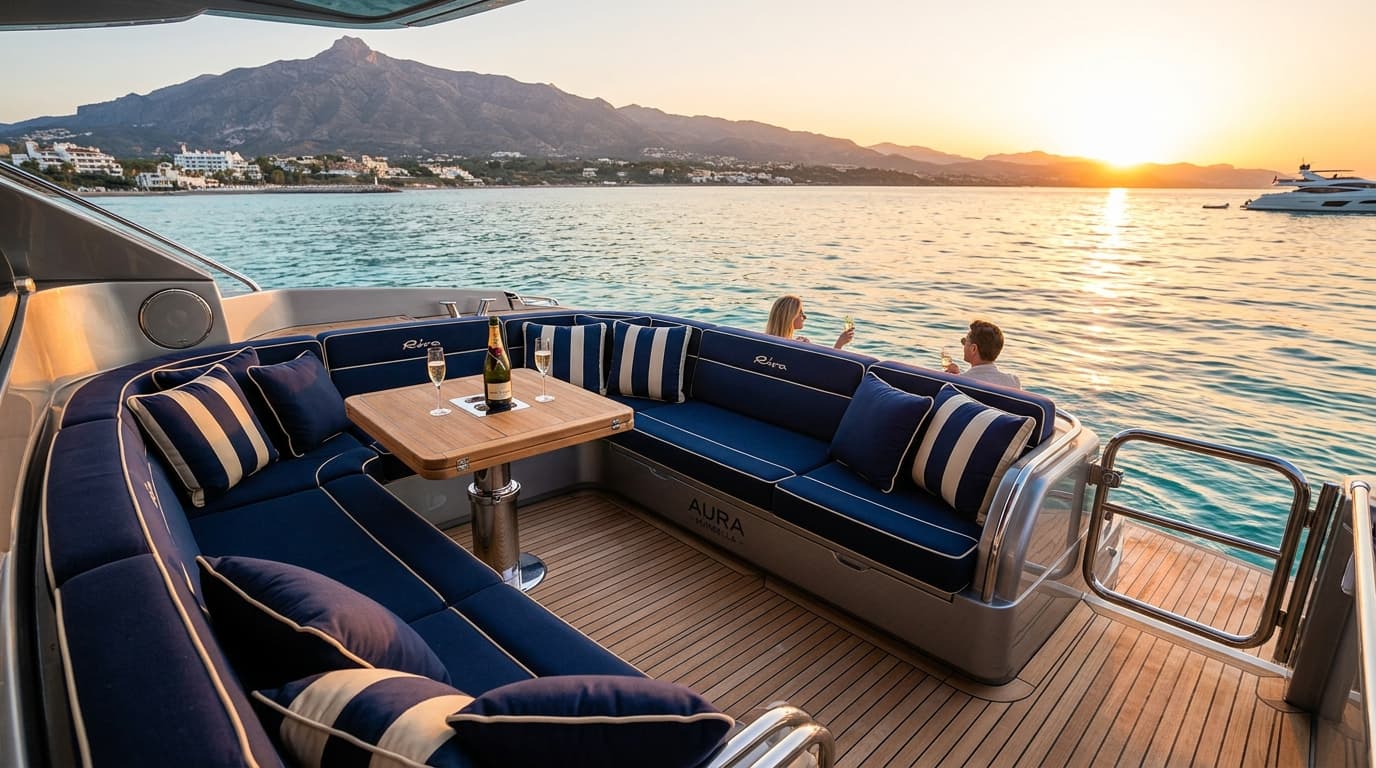 Illustrative image
Which yachts it applies to
The Red Ensign Group brings together the UK register and those of the Crown Dependencies and UK Overseas Territories, and shares a common yacht code. Part A applies to yachts of 24 metres load line length and over in commercial use for sport or pleasure, carrying no cargo and no more than 12 passengers. Part B covers those carrying 13 to 36 passengers, private or commercial. The current edition is July 2024.
A private yacht carrying 12 passengers or fewer falls outside Part A. Other flags have their own rules: the first thing is to know which flag the boat flies and how it is used.
Which test it has to pass
The reference is the International Maritime Organization’s International Code for Application of Fire Test Procedures — the 2010 FTP Code, adopted by resolution MSC.307(88). Part 8 is the test for upholstered furniture; Part 9, the test for bedding components.
The UK Maritime and Coastguard Agency requires upholstery and bedding on yachts certified under the Large Commercial Yacht Code to meet that code, or an equivalent it approves.
Inherently fire retardant, or treated
There are two routes. A cloth can be inherently fire retardant, by virtue of its fibre. Or another can be made so with a treatment. The MCA’s MGN 580 sets out how those treatments are approved, as an equivalent to inherently fire-retardant materials on vessels under 500 gross tonnage. At 500 and over, the same note requires upholstery, bedding and suspended textiles to be inherently fire retardant, unless the vessel has a fully addressable fire detection system.
And it sets a condition that matters: treated upholstery is tested to Part 8 after a simulated commercial dry-clean, following ISO 3175. The treatment has to survive cleaning, not just the day it goes on.
Inherently fire retardant
The protection is in the fibre, not in a finish.
Treated
Which is why it is tested after a simulated dry-clean: each clean can take something off.
Cleaning
The more often, the sooner renewal is due.
Renewal
The UK MCA sets a ceiling of 24 months between one treatment and the next.
A treatment has to be renewed
Under the same guidance note, re-treatment must take place within a period not exceeding 24 months, and sooner if the treated materials are regularly cleaned on board. Whoever applies the treatment must keep records for at least five years, including the washing and cleaning instructions for each treated fabric.
For the owner, the upshot is practical: cleaning the upholstery and the re-treatment schedule go together, and are best planned together.
What to ask before anything is upholstered
On a yacht that charters, or is about to, these questions come first:
- Use and flag
- Does the yacht charter, or is it purely private? Which flag does it fly?
- The test
- Does the upholstery pass Part 8 of the FTP Code? And the bedding, Part 9?
- The route
- Is the cloth inherently fire retardant, or treated?
- Renewal
- If treated, when was it done, and when is it due again?
- Cleaning
- How is it cleaned without weakening the treatment?
- Paperwork
- Who keeps the certificates and records, and where?
The service
An interior that has to pass survey?
Interiors, deck cushions and helm seating in marine-grade materials, with the material chosen for how the boat is used. The service page explains how the work is done.
Sources
The requirements come from the Red Ensign Group Yacht Code, the UK MCA’s MGN 580 and the IMO resolution that adopted the FTP Code. Each source was found by searching the publisher’s own site.
- MCA — MSN 1895, Red Ensign Group Yacht Code Part A
- Red Ensign Group — Yacht Code Part A, July 2024 edition (PDF)
- Red Ensign Group — Yacht Code Part B, July 2024 edition (PDF)
- MCA — MGN 580 Amendment 1: fire-retardant treatments for fabrics
- MCA — MGN 580, Appendix 1: approval procedures
- IMO — resolution MSC.307(88), the 2010 FTP Code (PDF)