

Deck cushion colour: which shade copes with the sun
Deck cushion colours are chosen with a sample card in hand, but the sun judges them differently: a dark shade gets hotter than a light one, and you feel it the moment you sit down in your swimwear. What the physics says, what makers have done so that dark shades don’t scorch, and what to ask before deciding.
By Royal Stitch · Published
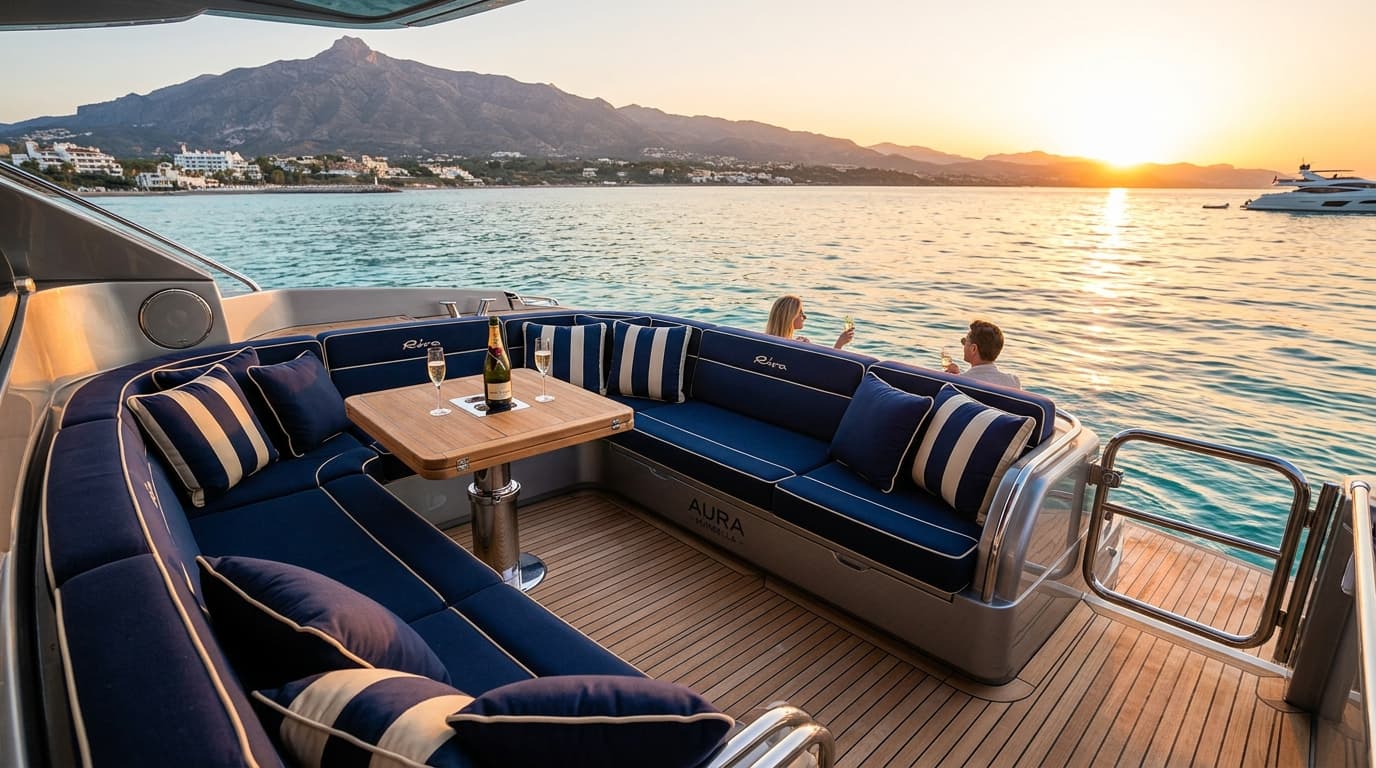 Illustrative image
Why a dark cushion burns
Lawrence Berkeley National Laboratory in the US sets it out in its guidance on cool roofs: solar reflectance is the share of sunlight a surface sends back, and whatever isn’t reflected is absorbed as heat. Dark materials reflect far less than light ones.
NASA puts it simply in an education activity from its JPL laboratory: under the same conditions, a dark object gets hotter than a bright one. In a cockpit under the August sun, you feel that difference on your skin.
Dark shade
Reflects little sunlight and turns it into heat.
Light shade
Reflects more: it stays cooler.
Reflective dark
Sends back the infrared; according to its maker, it runs cooler.
A dark shade that reflects
Much of the sun’s heat arrives as light you can’t see: the near infrared. The same Berkeley laboratory has developed pigments that reflect that part of the spectrum, so a dark colour heats up less while still looking dark. They were designed for roofs.
In marine upholstery, Morbern applies the idea to its Koolfab vinyl: according to the maker, it reflects infrared to lower the surface temperature, and it notes that outdoor vinyl used to have to be white or light to stay cool. That is the seller speaking, so it is worth asking for its test data.
Colour that stays
Whether a shade stands up to the sun is a separate question: whether it fades. Sunbrella explains that its marine fabrics are solution-dyed, with the colour inside the fibre, which is why they hold it in the sun. That goes for dark and light alike.
Where each shade goes
Given all that, a sensible approach is to think about where the sun falls:
In the end, the shade is chosen with samples in hand, on the boat itself.
- Where people lie in the sun
- Sun pads and unshaded seats: light shades, or a dark made to reflect heat.
- Where there is shade
- Under the bimini or awning, the shade is freer.
- Piping and trim
- A dark shade on the edges gives contrast without heating the seat.
What to ask before choosing a shade
With these answered, the colour is chosen for how it will be lived with too:
- Placement
- Full sun, or shade?
- Heat
- Does the material use any technology to reflect the sun? Is there test data?
- Colour
- Is it in the fibre, or on the surface?
- Trim
- Where can the dark shade go without anyone sitting on it?
- Sample
- Can you see it in the sun, on the boat?
The service
New cushions for your boat?
Saloon, cabin and cockpit upholstery for boats on the Costa del Sol, patterned on each piece. The service page explains how the work is done.
Sources
The heat comes from a US public laboratory and NASA; the reflective vinyl, from its maker; colour, from a marine fabric maker. Each source was found by searching the publisher’s own site.